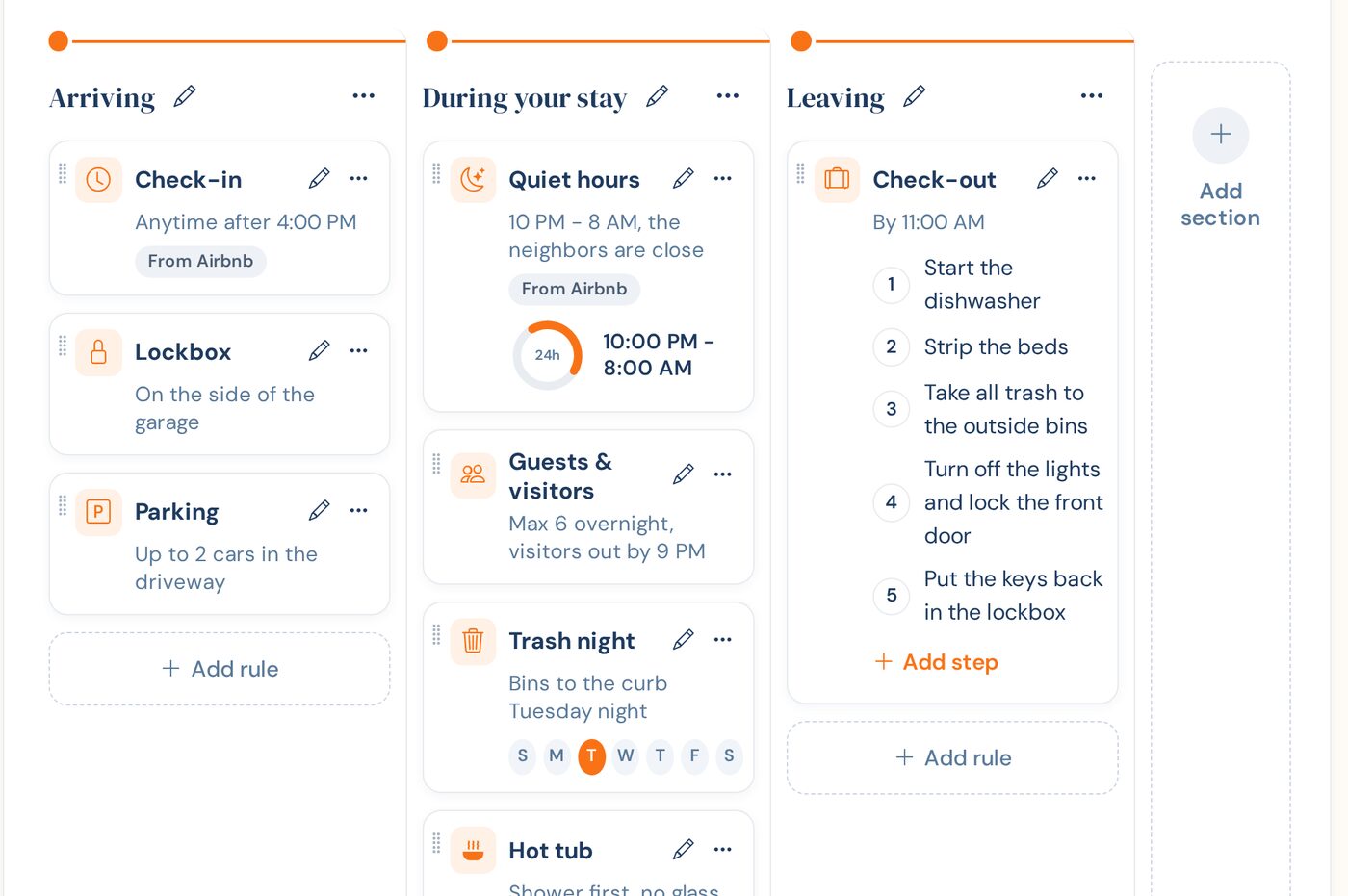
Good house rules are short and specific, written for the person standing in your driveway with a suitcase. Most problems hosts have with rules come from one of two places: the rule wasn’t there when the guest needed it, or it was worded so vaguely that the guest could read it any way they liked. “Be respectful of neighbors” gets ignored. “Quiet hours are 10 PM to 8 AM because the neighbors are close and the walls are thin” mostly doesn’t.
Below is what to include, how to word it, what to keep off the public listing, and a template at the end that you can copy and adapt.
What to include
You don’t need a rule for everything. Cover the things that cost you money or would otherwise turn into a text message at 11 PM.
Check-in and access
The check-in time, how to get in, and where the keys go when guests leave. Say where the lockbox or keypad actually is (“on the side of the garage”, “left of the front door, under the light”), because “use the lockbox” isn’t much help in the dark. The code itself belongs in the booking message, not the listing; more on that below.
Parking
How many cars, where exactly, and where not. If an HOA or the town tickets or tows, say so, because it explains the rule and guests take it more seriously. “Up to 2 cars in the driveway. No parking on the grass or overnight on the street (the HOA tickets).”
Quiet hours
Give the hours and a reason. Guests are far more likely to keep it down when they know the neighbors are twenty feet away than when they read a generic “no loud noise”.
Guests, visitors and parties
The overnight maximum should match your listing and your insurance. If daytime visitors are fine, say until when. “No parties or events” is clearer than “no large gatherings”, which invites guests to decide what large means.
Smoking and vaping
Say where it’s not allowed and include the places people assume are fine, like the deck, the balcony or the garage. If there’s a smoking area, say where it is.
Pets
Either “no pets” or the exact terms: how many, what size, whether they’re allowed on furniture, and any fee. Assistance animals aren’t pets. Airbnb and many local laws require you to accept them, so don’t write a rule that says otherwise.
Trash and recycling
This is the rule hosts forget and then pay for. Give the pickup day, when bins go to the curb, and which bin is which. If the bins are hidden behind a gate, say so.
Pool or hot tub
Keep it to safety and to the things that cost you money: shower first, no glass, how young children must be supervised, and putting the cover back on so it doesn’t lose heat overnight. Add the hours if your local rules or your neighbors require them.
Grill and fire pit
Where the propane is, turning the tank off after use, keeping the lid closed, and whether the fire pit is allowed during burn bans. If firewood is provided, say where it is.
Thermostat
A range rather than a single number, plus the one habit that matters most: closing the windows when the AC is running.
The check-out list
Five or six steps that genuinely save your cleaner time, numbered, in the order guests would do them. Starting the dishwasher, stripping the beds, taking the trash out, turning off the lights and locking up, and returning the keys covers most homes. A long list of chores makes guests feel like unpaid staff and tends to show up in reviews.
How to word rules so guests follow them
- Say what to do, not only what not to do. “Roll the bins to the curb Tuesday night” works better than “Don’t leave trash out”.
- Give a short reason for the rules that seem arbitrary. The reason is what makes people comply when nobody’s watching.
- Use numbers: times, counts, temperatures, days. “Late” and “a few” mean different things to different people.
- Keep each rule to one or two sentences. If it needs a paragraph, split it into a short rule and a details note.
- Put each rule where guests will need it. Parking and access go first; the check-out list goes last.
- Drop the capital letters and the warnings about fines in every line. A friendly, firm tone works better, and you can keep the fine for the one rule that really needs it.
What not to put in public listings
Your Airbnb or VRBO listing, and any guidebook link you share publicly, can be read by anyone. Keep these out of it:
- Door, lockbox and gate codes
- Wi-Fi passwords
- Alarm codes and where spare keys are hidden
- Anything that tells a stranger the house is empty between bookings
Send these with the booking: in the check-in message, or in a guidebook that only shows them while a guest is booked. Change door codes between stays if your lock allows it. The template below uses obviously fake codes; replace them, and keep the real ones out of anything public.
A house rules template you can copy
This is based on a real-world style of welcome note for a small cottage. Replace the details in square brackets and delete anything that doesn’t apply.
Welcome to [Property name]! A few house rules so everyone has a great stay.

ARRIVING
Check-in is anytime after [4:00 PM].
Use the lockbox on [the side of the garage]. Your code is in your booking message.
Please return both keys to the lockbox when you leave.

Parking
- Up to [2] cars in the driveway
- No parking on the grass or overnight on the street ([the HOA tickets])

Wi-Fi
Network and password are in your booking message and on the TV.

DURING YOUR STAY
Quiet hours: [10 PM to 8 AM]. Our neighbors are close and the walls are thin.
Guests: no parties or events, and max [6] guests overnight. Visitors need to leave by [9 PM].
Smoking: no smoking or vaping anywhere, including the [deck].
Pets: sorry, no pets.
Trash: pickup is [Wednesday morning], so please roll the bins to the curb [Tuesday night]. Recycling goes in the [blue] bin, rinsed please.
Hot tub: shower first, no glass, and kids under [12] must be supervised. Put the cover back on when you're done, or it loses heat overnight.
Grill: the propane tank is in the [shed]. Turn the tank off after use and keep the lid closed.
Thermostat: it's set to [72]. Please keep it between [68] and [76], and close the windows when the AC is running.

BEFORE YOU LEAVE (check-out by [11:00 AM])
1. Start the dishwasher
2. Strip the beds and leave the sheets on the bathroom floor
3. Take all trash to the outside bins
4. Turn off the lights and lock the front door
5. Put the keys back in the lockbox

Thanks for staying with us!
Compared with how hosts often write this, two things changed. The lockbox code (say, 2580) and the Wi-Fi password were taken out of the text and moved to the booking message, and the check-out steps went from one long line onto separate numbered lines, which is much easier to follow on a phone or a TV.
Getting rules in front of guests
A rules page in the listing gets read once, if at all, before the trip. During the stay, guests look at the TV and their phone far more than at the listing. If you use WelcomeSign, you can paste this template straight in: Import Your House Rules from Airbnb or Paste Them In shows how it becomes cards with codes kept to the booking, and How to Add House Rules to Your Vacation Rental TV covers editing them and the check-out list.
Whatever you use, read your rules once a season with fresh eyes. If guests keep asking the same question, the answer is either missing or in the wrong place.
Need Help?
Email support@welcomesign.com, browse the help center, or use the chat button in the bottom-right corner of your dashboard.
WelcomeSign shows your house rules and check-out list on the rental’s TV and in a phone guidebook.